
AI Designed for Conversation: Retail Drive Through as the Moment of Truth for Voice Systems
Voice AI in drive-through sounds simple. Real deployments tell a different story. Explore why edge processing is now key to making conversational AI work at scale.

Written by
Adam Pietrzak
AI Lead

Originally published in Polish on Omnichannel News (March 2026)
For the largest Quick Service Restaurant (QSR) chains, particularly in the US market, drive-through accounts for more than half of revenue, and for leaders such as Wendy’s, as much as 60–70% of transactions are completed without leaving the car. This makes it one of the key customer touchpoints. Any delay or error in an order directly affects throughput, overall operational efficiency, and customer satisfaction.
Industry data (QSR Drive Thru Report 2024; 2025) shows that the average total service time at drive-through is around 5–6 minutes, while order accuracy hovers at approximately 87–89%, meaning that slightly more than 10% of orders contain an error. At scale, this results in numerous corrections, delays to subsequent orders, and additional workload for staff.
Why QSR Chains Are Turning to Conversational AI
It is therefore no surprise that QSR chains are increasingly turning to AI-driven order-taking automation. Conversational AI systems that engage in natural-language dialogue become tools that genuinely improve service, address staff shortages, and respond to growing customer expectations.
However, retail drive-through very quickly tests the promise of voice technologies. In this environment, it is not enough for a system to recognise speech well; it must also respond well. The quality of the conversation depends on the system’s ability to adjust tone, pace, and language to the situation and the customer. It must also handle mixed-language speech naturally, since even native-language conversations routinely include borrowed words and phrases from other languages.
What Actually Determines Voice AI Performance
Technically, the effectiveness of voice systems is often reduced to metrics such as WER (Word Error Rate), which measures the proportion of words recognised incorrectly. Under laboratory conditions, modern models achieve single-digit WER values; however, in a real drive-through environment (with noise, echo, and wind), error rates of over 12 per cent are not uncommon. From an operational perspective, this is a level at which the technology stops supporting service and begins to complicate it.
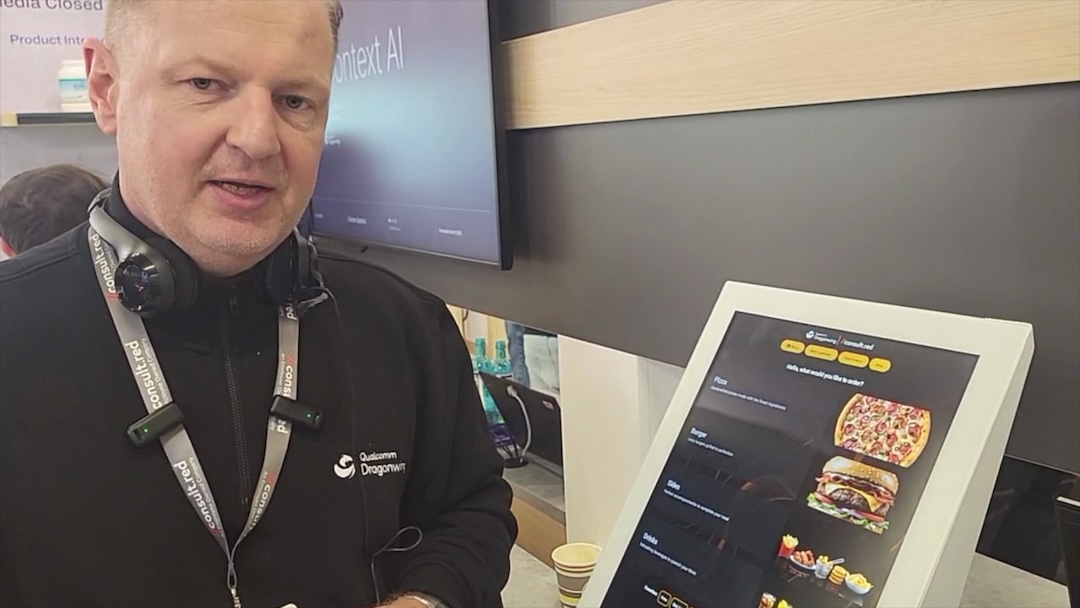
In practical deployments, the quality of conversational AI is determined not by a single model, but by the entire pipeline: audio capture, signal cleaning, speech recognition (ASR), intent understanding (NLU), dialogue orchestration, and speech synthesis (TTS). Increasingly, not only audio processing but also the ASR and NLU models themselves operate at the edge.
The Case for Processing at the Edge
This explains the growing importance of Edge AI (on-device AI), an approach in which key processing is performed locally on the device rather than in the cloud, enabling stable, real-time processing, low latency, and greater resilience to interference.
This has direct operational significance: connectivity issues can degrade cloud-only systems, while cost models based on per-interaction billing can increase rapidly with high order volumes. Edge processing helps mitigate both risks and serves as a local safeguard in the event of connectivity issues.
Hybrid Deployment: A Practical Path to Automation
At current accuracy levels, hybrid deployments are also possible, in which AI operates alongside an employee, verifying orders in the background and flagging potential discrepancies. With 11–13% error rates, even such a scenario can significantly reduce costs and enable safe A/B testing before adopting full automation.
Importantly, these scenarios are no longer just a vision for the future. Hardware platforms available today offer sufficient computational power to run modern voice solutions at the edge, and their capabilities and cost-effectiveness will continue to improve.
The Broader Lesson for AI in Operations
Retail drive-through illustrates a broader truth about AI in omnichannel operations: when technology becomes part of a critical operational process, what matters is not the algorithm’s efficiency, but the consistency and reliability of the entire system.
Edge AI provides key value wherever the quality of experience depends on low latency, stability, and predictability of voice systems.
If your business is exploring how Edge AI can improve reliability, reduce latency, or cut cloud processing costs, Consult Red can help.
Related Insights
Articles
The Joy of PoCs
Why a small and early proof of concept (PoC) can save you much, much more in the long run.
Articles
Fastest Doesn’t Always Mean Best: Optimising an Edge AI Pipeline on Rubik Pi 3
The fastest Edge AI pipeline isn’t always the right one: Python, C++, and GStreamer on the Rubik Pi 3’s NPU, compared on speed, CPU, memory, […]

Videos
Simply Explained: Why Your Router Should Be Doing the AI in the Connected Home
Watch our CTO, Rahul Mehra, unpack the full case for anchoring edge AI in the broadband router.