
Embedded Software Development
Production-quality embedded software, built by engineers who understand the hardware it runs on.
Consult Red develops embedded software for connected devices across consumer electronics, broadband, industrial, and healthcare markets.
Our engineers work across the full software stack, from low-level drivers and BSPs through to middleware, application frameworks, and cloud integration, on the SoC platforms and architectures used in real-world production programmes.
Our embedded software runs in more than 100 million deployed devices worldwide.
The risks that embedded software projects run into
Software written without full knowledge of the underlying hardware creates problems that surface late.
Memory constraints missed at architecture stage. Driver instability that only appears under load. Power management assumptions that do not hold in production silicon. Security requirements discovered after the software stack is already defined.
We work with hardware and software together from day one. That means the decisions that create risk later get addressed at the point where they are cheapest to fix.

Consult Red embedded software development capabilities
We develop embedded software across the full stack, from silicon bring-up through to the application layer, on the platforms and architectures used in connected devices at production scale.

BSP Development and Porting
Board Support Package development, porting, and customisation for new hardware platforms. We build the foundational software layer that connects OS and hardware, ensuring stable, optimised bring-up on your target silicon.
Device Driver Development
Low-level driver development for custom peripherals, interfaces, and SoC subsystems. Written in C and assembly where performance demands it, with full knowledge of the target architecture – MIPS, ARM, x86, and RISC-V.
Embedded Linux
Custom Linux development, kernel configuration, and system integration for resource-constrained connected devices.
Embedded RTOS
Real-time OS (RTOS) development for time-critical and safety-critical applications requiring deterministic behaviour.
Middleware Development
Abstraction layers, protocol stacks, and middleware components that provide common interfaces to higher-level software. We work with established frameworks and develop custom middleware where standard solutions do not fit the constraints.
Performance Optimisation
Optimisation of software for constrained CPU and memory environments. We use cross-compilation, architecture-specific libraries (uClibc, eglibc, bionic), and hand-optimised assembler for Neon and SSE where performance is critical.
Software Integration and System Validation
Integration of third-party SDKs, platform middleware, and application frameworks. End-to-end system testing against real hardware to validate behaviour under production conditions.
Security Implementation
Roots of trust, hardware security module integration, and secure boot implementation. Device Security built into the software stack from architecture stage, not added as a layer at the end.
Platform and architecture experience
We develop embedded software across the leading SoC families used in connected devices — including Amlogic, Broadcom, Qualcomm, Realtek, ST, NXP, and Texas Instruments. We are not tied to any single vendor. Our recommendations on platform selection are based on the requirements of the project, not on preferred supplier arrangements.







Developing software for embedded systems requires working within constrained memory and CPU environments. To meet this challenge, we can cross-compile for the target architecture, and use libraries optimised for footprint size, such as uClibc, eglibc, bionic, LwIP, and Mongoose web server.


Security in embedded software
Security in embedded devices cannot be added at the end of a project. The decisions that determine a device’s security posture are made early in the SoC selection, boot architecture, and software stack layering. Getting those decisions wrong is expensive to fix and, increasingly, a route to regulatory non-compliance.
We treat security as a thread throughout development, not a final gate. That means roots of trust, secure boot, and hardware security module integration from the outset — with trust boundaries defined and enforced across every software layer. For safety-critical applications, redundancy, majority voting, and fail-safe switching are addressed at the architecture stage, before production code is written.
For clients who need deeper support on device security strategy and compliance, including EU CRA, UK PSTI Act and EU EN18031, our Device Cybersecurity practice provides assessment, architecture, and implementation services across the full product lifecycle.

Why work with Consult Red for embedded software development

Software that knows the hardware
We develop embedded software alongside hardware, not after it.
Our chip-to-cloud capability means the engineers writing your software have direct access to the people who designed or selected your hardware.
That removes the handover gap where most embedded project risk lives.

20+ years, 100M+ deployed devices
Our embedded software runs in more than 100 million devices deployed in households across Europe, North America, and other global territories.
We have been developing for constrained, production-scale environments since 2003. That depth of experience is visible in how we approach architecture decisions, not just in how we write code.

Delivered as a team, not a contractor
We operate as embedded pod teams integrated into client programmes, or as a primary development partner with end-to-end responsibility.
Either model gives you access to engineers who average over 12 years of industry experience and who are accountable for outcomes, not just hours.
Frequently asked questions about embedded software development
-
What is embedded software development?
Embedded software development is the creation of software that runs on dedicated devices rather than on general-purpose computers.
It operates within strict constraints on memory, processing power, and power consumption, and must interact directly with hardware peripherals and interfaces. Embedded software spans multiple layers — from low-level device drivers and board support packages through to middleware, application logic, and connectivity stacks.
-
What is the difference between embedded software and firmware?
Firmware is a subset of embedded software, typically the low-level software stored in non-volatile memory that initialises hardware and provides basic device control.
Embedded software is a broader term covering the full software stack on a device, including firmware, OS, middleware, and application layers. In practice, the terms are often used interchangeably for lower-level device software.
-
What is a BSP in embedded systems?
A Board Support Package (BSP) is the collection of software components that enable an operating system to run on a specific hardware platform.
It typically includes hardware initialisation code, device drivers, memory configuration, and the build system configuration required to compile software for the target device.
A well-developed BSP is the foundation of a stable, optimised embedded software stack.
-
What programming languages are used in embedded software development?
C and C++ are the most widely used languages for embedded software, particularly in performance-critical, memory-constrained environments.
Assembly language is used for the most performance-sensitive routines, such as signal processing or hardware initialisation.
Higher-level languages, including Python, Java, and JavaScript, are used for application layers where hardware abstraction is available, and execution speed is less critical.
-
How do you manage security in embedded software?
Security in embedded software begins at the architecture stage with decisions about roots of trust, secure boot, and hardware security module integration.
We implement security as a thread through the development process, defining the security model during architecture, implementing secure boot and key management during firmware development, and validating the implementation through our compliance and security review process.
Security requirements discovered after software design is complete are significantly more expensive to address.
Ready to discuss your embedded software project?
Whether you need a specialist to address a specific layer of your software stack or a full-stack partner from architecture through to production, we have the experience and the team to help.
Related Insights
Our recent work and thinking on embedded software development across industrial, media, and broadband verticals.
Guides
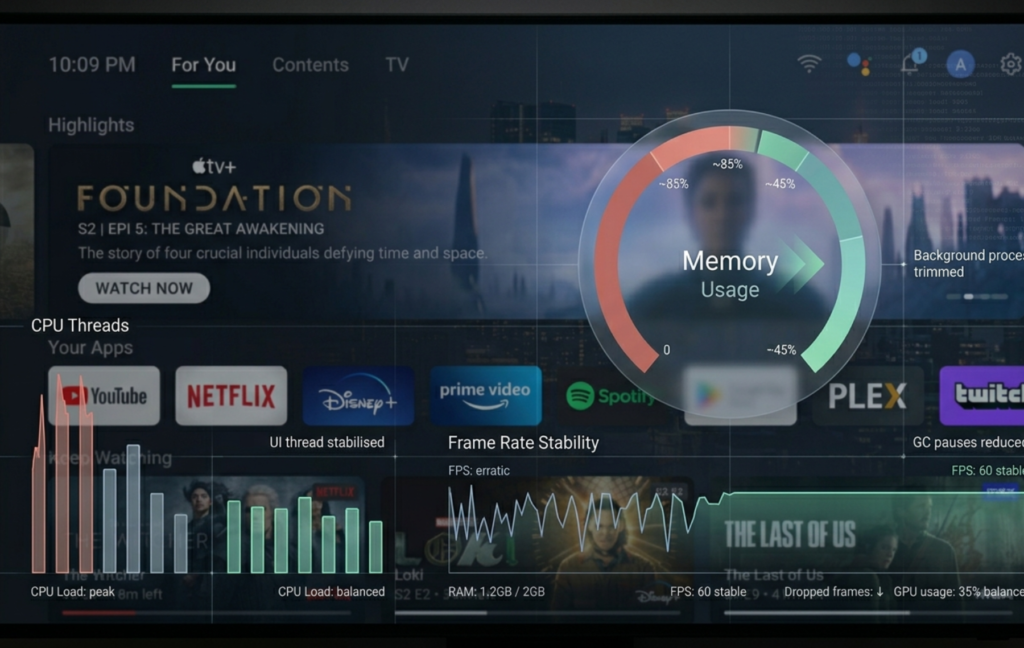
Android TV Performance Optimisation: A Practical Guide for RAM-Constrained Devices
This guide covers the approaches that reliably move the needle, from the first diagnostics you should run today to the deep engineering trade-offs that separate […]

Case Studies
Linux-based touchscreen control device
The client needed to upgrade a limited microcontroller-based touchscreen to a full-featured Linux control system.

Articles
The Hidden Costs of Choosing the Wrong Product Architecture
In this article, we explore the foundations that make connected product evolution possible and successful.