
Edge vs Cloud AI: What’s Right for Your Product?

Artificial intelligence is becoming increasingly practical for embedded and connected products. Advances in tooling, silicon, and deployment frameworks mean that capabilities once reserved for large cloud platforms can now run closer to the device, or even directly on it.
For product teams, this opens up real opportunities, but also introduces new architectural decisions with long-term consequences.
One of the most important questions is no longer simply whether AI can be added to a product, but how to adopt it efficiently. That includes understanding when AI adds genuine value, and where it should operate to balance performance, cost, privacy, and scalability.
At Consult Red, we work with product owners, CTOs, and innovation leads to build connected devices and smart services across the industrial, media, and broadband sectors. A consistent challenge we see is not AI capability itself, but making the right architectural choices early enough to avoid rework later.
This article is intended as a practical guide to choosing the right AI architecture, whether that is cloud, edge or hybrid.
First Things First: Is AI the Right Approach for This Problem?
Before deciding where to run it, it is worth taking a moment to validate that AI is the right tool for the job.
AI is most effective when it addresses problems that are difficult to solve with traditional approaches. In embedded products, this often includes scenarios where behaviour needs to adapt to changing conditions, where patterns are hard to define explicitly, or where manual tuning does not scale. AI tends to add the most value when:
- The operating environment is variable or unpredictable
- The system needs to learn from real-world data
- Behaviour must improve over time without constant reconfiguration
- The cost or complexity of rule-based approaches is growing
In many products, AI complements existing logic rather than replacing it. It may be introduced gradually, supporting specific functions while the rest of the system remains deterministic.
The goal at this stage is not to challenge the use of AI, but rather to ensure it is applied intentionally. Teams that take this step early tend to make cleaner architectural decisions later, particularly as products scale or evolve.
When AI Is the Right Tool, Architecture Matters
Once AI is part of the solution, architectural choices become critical.
For embedded and connected products, this usually comes down to where AI runs:
- Cloud AI, where data is processed remotely
- Edge AI, also referred to here as On-Device AI, where inference runs directly on the embedded hardware
In some systems, AI may also run at the network edge on a local gateway or server. But for most product teams, the core decision is between cloud and device, or a combination of both.
This choice influences far more than model performance. It affects responsiveness, reliability, privacy, cost structure, and how easily the product can evolve over time.
Teams that treat AI architecture as a primary product decision alongside hardware selection and system design are far better positioned to adopt AI efficiently and sustainably.
It is also important to consider the machine learning lifecycle, not just initial deployment. Data collection, retraining cadence, and model drift all influence architectural choice. Architectures that separate training from inference, often through cloud or hybrid approaches, can make it easier to evolve models over time without destabilising the product.
The AI Architecture Triangle: Three Forces, Not One Trade-off
Where AI runs is not a single trade-off. It is a balance between three forces:
- Intelligence – how capable and context-aware the system is. Cloud AI draws on vast general knowledge and heavy reasoning power. Edge AI is typically lighter, but closer to the specific context of the device and the person using it.
- Immediacy – how quickly the system responds, and whether it keeps working when connectivity drops. Edge AI wins here by design; cloud AI is only ever as fast as the network allows.
- Economy – the shape of the cost curve. Edge shifts spend to upfront hardware, which is predictable but fixed. Cloud shifts it to ongoing usage, which scales with demand but gets harder to forecast, and more expensive, as volume grows.
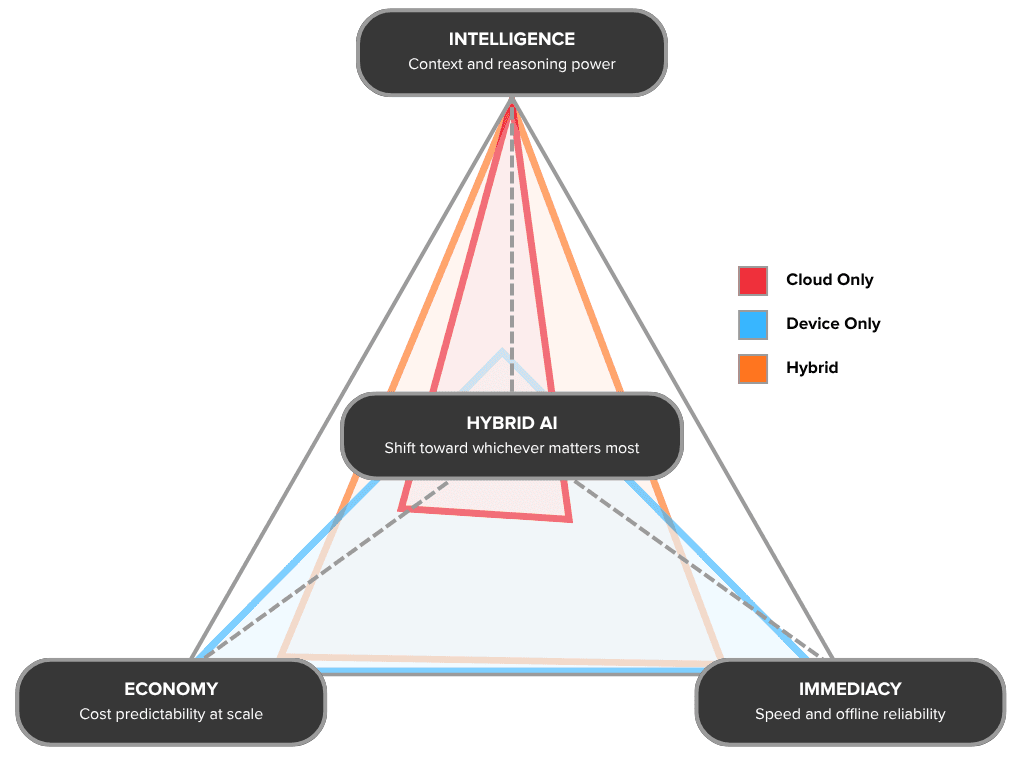
Unlike a classic “pick two” trade-off, hybrid architectures are not fixed to one corner of this triangle. They can shift the balance depending on what a specific task needs: keeping high-frequency, latency-sensitive processing on the device, while reserving cloud compute for the reasoning that genuinely requires it. That flexibility is powerful, but it is not free. It adds integration complexity, and a second thing to secure, update and operate.
This also affects security and update strategy. Where models run affects the attack surface, how intellectual property is protected, and how safely models and dependencies can be patched over the product’s lifetime. These are strategic considerations, not implementation details, and belong alongside core product architecture decisions rather than as an afterthought.
Cloud vs Edge (On-Device) vs Hybrid AI: A Practical Comparison
Once AI is on the table, most teams end up choosing between three architectural approaches. The table below maps the ten factors that most influence this decision against the three forces above.
- Cloud AI, where intelligence runs remotely
- Edge AI (On-Device AI), where inference runs on the product itself
- Hybrid AI, which splits responsibility between device and cloud
Each option shifts the balance between performance, cost, complexity, and control.
| Factor | Cloud AI | Edge AI (On-Device) | Hybrid AI |
|---|---|---|---|
| Latency | Variable, network dependent | Consistently low | Low for core functions |
| Connectivity required | Always | None | Partial |
| Offline operation | Not possible | Full | Limited but graceful |
| Data privacy | Lower | High | Medium to high |
| Real-time capability | Limited | Strong | Strong for local decisions |
| Updatability | Simple and frequent | Requires planning | Flexible but complex |
| Scalability | High, usage based | Cost limited | High with coordination |
| System complexity | Lower (device side) | Moderate | Highest |
| Cost profile | Ongoing cloud OPEX | Upfront device CAPEX | Mixed CAPEX and OPEX |
| Best suited for | Analytics, experimentation | Real-time, privacy critical | Products needing both |
This pattern is consistent in practice:
- Cloud AI favours speed of iteration and central control
- Edge AI favours performance, reliability, and privacy
- Hybrid AI favours flexibility, at the cost of added complexity
None of these is universally “better”. The right choice depends on which trade-offs matter most to your product and customers.
Common Mistakes When Choosing an AI Architecture
Even when the high-level trade-offs are understood, we see the same architectural mistakes repeated across products. These are rarely technical failures. They are usually the result of mismatched assumptions.
Cloud AI: common mistakes
- Assuming low or predictable latency in real-world networks
- Underestimating long-term cloud operating costs at scale
- Treating privacy and data residency as problems to solve later
Edge AI (On-Device AI): common mistakes
- Selecting hardware before understanding model requirements
- Underestimating the effort required for secure model updates
- Treating edge deployment as “set and forget” rather than a managed lifecycle
Hybrid AI: common mistakes
- Choosing hybrid by default rather than by necessity
- Blurring responsibility between cloud and device, leading to brittle systems
- Accumulating complexity without a clear operational ownership model
How AI Architecture Choices Vary by Industry
While the architectural trade-offs between Cloud, Edge, and Hybrid AI are broadly consistent, how they play out in practice varies significantly by industry.
The most effective product teams do not start with a preferred architecture. They start with the realities of their operating environment, regulatory constraints, and customer expectations.
Below are some common patterns we see across the industries we work with most closely.
Industrial and Manufacturing
In industrial environments, reliability and predictability usually matter more than product sophistication.
Many industrial products operate:
- In harsh or remote conditions
- With intermittent or no connectivity
- Under strict safety and compliance requirements
As a result, industrial devices often have good reasons to make decisions locally, whether using Edge AI (on-device AI) or more traditional algorithms. Typical applications include anomaly detection, condition monitoring, and quality inspection, where decisions must be made in real time, and systems must continue operating even when disconnected.
Hybrid approaches tend to be deliberate and constrained, typically combining local inference with periodic cloud-based optimisation. In triangle terms, this is Immediacy and Economy taking priority over raw Intelligence.
Media and Entertainment
In media-focused, consumer-facing products, user experience, responsiveness, and perceived intelligence matter, but so do cost, power consumption, and time-to-market. Devices may be deployed at scale, making per-unit cost and update strategy critical.
Here we often see:
- Edge AI (on-device AI) is used for local responsiveness, personalisation, or content-related features
- Cloud AI used for analytics, recommendations, and service-level optimisation
Hybrid AI is often a strong fit for this vertical because it supports privacy-by-design. Sensitive data or inputs can be processed locally on the device at the edge, while only anonymised data or metadata are sent to the cloud. This reduces exposure and makes it easier to meet regulatory and privacy requirements without sacrificing the product experience or the benefits of cloud-scale learning.
Teams may also introduce AI later in the product lifecycle, via a device software update or in the cloud, once usage data clearly shows where it adds value. This is the triangle balancing act at its clearest: Immediacy and Intelligence held together through hybrid, with Economy managed through selective cloud use.
Broadband and Telecoms
Broadband and telecoms products sit at the intersection of infrastructure and consumer experience.
They typically involve:
- Large installed bases
- Good connectivity
- Long product lifecycles
- A mix of local decision-making and central network intelligence
In this context, Hybrid AI is often attractive, but also risky if not well constrained.
Hybrid approaches can be effective, combining local diagnostics or optimisation with fleet-wide cloud analytics. Increasingly, this is driven by hardware: many modern broadband gateways now integrate NPUs or DSPs, making on-device inference more practical than historically. This can shift the architectural balance towards edge or hybrid approaches, particularly for real-time diagnostics, fault detection, or optimisation. As NPUs proliferate in gateways, Economy and Immediacy increasingly pull in the same direction: toward the device.
A Consistent Theme Across Verticals
Across industrial, media, and broadband products, one theme is consistent.
The right AI architecture depends less on the technology itself and more on:
- Operating conditions
- User expectations
- Regulatory and privacy constraints
- Cost and lifecycle considerations
Four Questions to Guide the Decision
Before committing to an AI architecture, product teams should be able to answer these questions to help avoid the architectural dead ends we see when products outgrow their original assumptions.

The severed wire test: what happens when connectivity is lost?
If failure is unacceptable, edge AI is often the safer option.
The reflex test: how quickly must the system respond?
Human-facing, safety-critical, or “stop that alarm now” interactions need on-device speed. A few seconds of cloud delay is not a UX flaw in these cases; it is a risk.

The exposure test: what data leaves the device?
Privacy, regulation, and customer trust increasingly push intelligence closer to the device.
The utilisation test: is the workload spiky or flat?
Predictable, steady workloads suit cloud economics. Spiky workloads- a morning rush of queries, a shift-change surge on a factory floor- mean paying for peak capacity that sits idle the rest of the time, unless some of that load is absorbed locally.
Building Smart Products Without Overengineering
The strongest product teams share a common approach. They decide early whether AI is genuinely required, weigh the decision against Intelligence, Immediacy and Economy rather than technology preference, and design for evolution rather than initial launch.
At Consult Red, we help teams make these decisions from first principles. Sometimes that means edge AI. Sometimes cloud or hybrid. Often, it means no AI at all.
As Tom Wood, Head of Engineering, puts it:
“The hard part is not getting AI running. It is deciding where it belongs, and where it does not.”
Choosing between Cloud, Edge, and Hybrid AI is easier once you know which of the three forces – Intelligence, Immediacy, or Economy – matters most for your product, and where you are willing to compromise.
Talk to an expert about your product architecture
If you are exploring AI for an embedded or connected product, and want an objective view on whether cloud, edge, hybrid, or no AI at all is the right answer, talk to one of our experts.
Some images on this page are AI-generated and used for illustrative purposes.
Related Insights
Articles
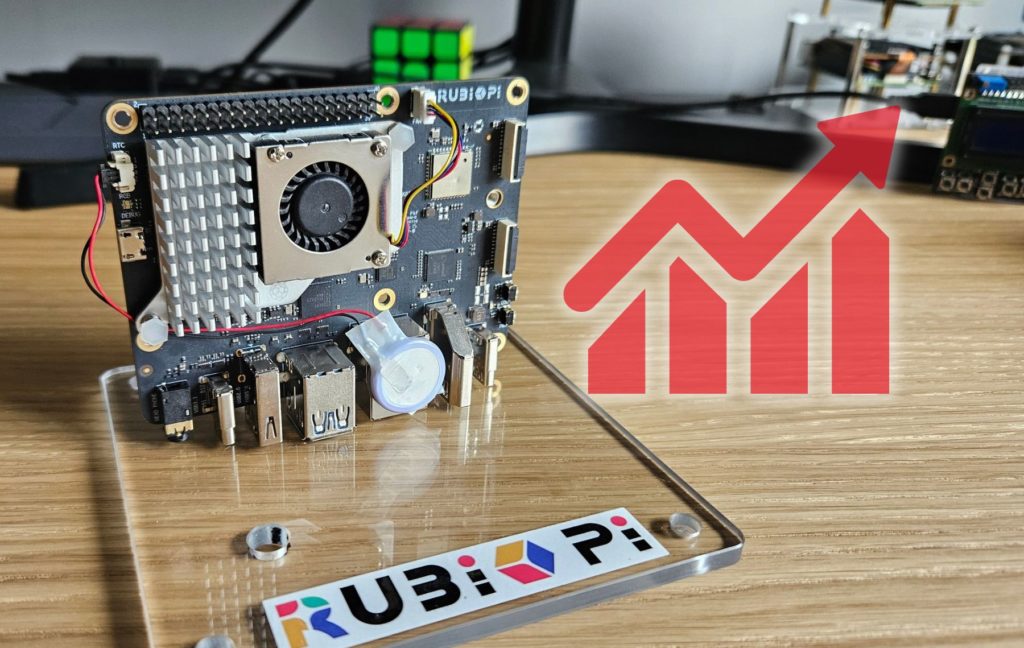
Fastest Doesn’t Always Mean Best: Optimising an Edge AI Pipeline on Rubik Pi 3
The fastest Edge AI pipeline isn’t always the right one: Python, C++, and GStreamer on the Rubik Pi 3’s NPU, compared on speed, CPU, memory, […]

Videos
Simply Explained: Why Your Router Should Be Doing the AI in the Connected Home
Watch our CTO, Rahul Mehra, unpack the full case for anchoring edge AI in the broadband router.
Case Studies
Secure Hardware Delivered at Speed
UK cybersecurity hardware specialist needed to compress a rapid, high-stakes carrier board design cycle for a new high-speed encryption product, with no margin for rework.