
AI-First Embedded Engineering
Faster delivery. Same quality output you can trust.
Consult Red combines AI-first software engineering with 20+ years of embedded, connected-device expertise.
That combination is what makes faster delivery something you can rely on, not just something that sounds fast, whether you’re augmenting your own team with a Consult Red team or bringing us in for a fully managed piece of work.
The AI-first shift
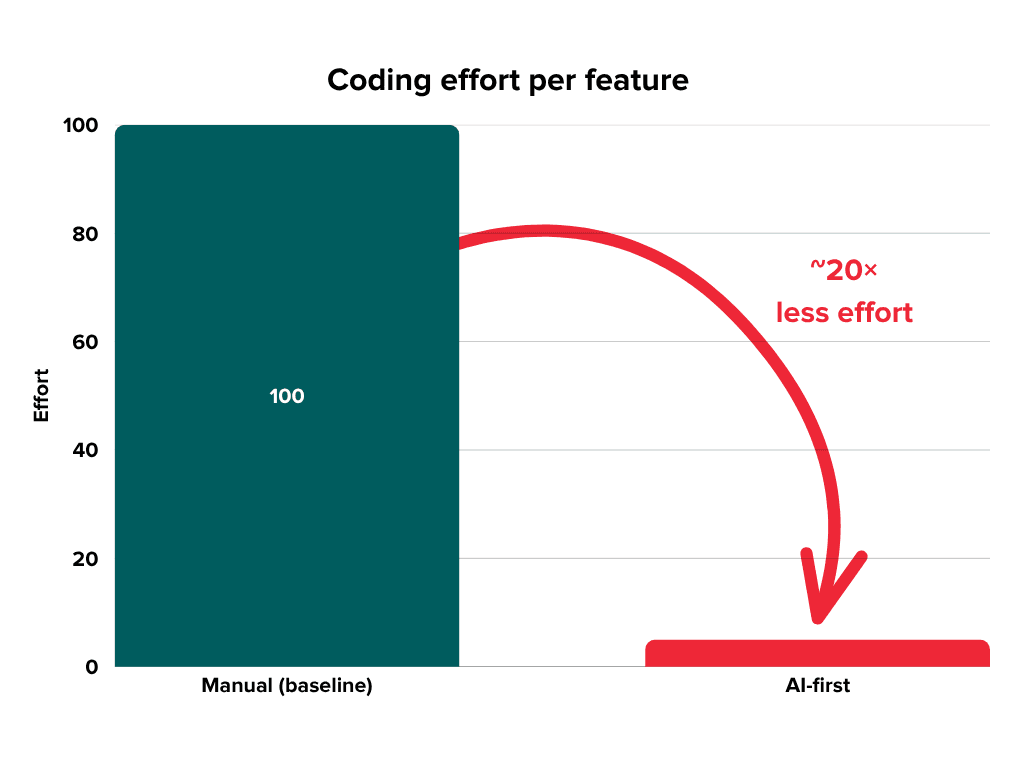
Software development is getting radically faster. On real engineering work, we’ve measured 20x savings in coding effort while maintaining or even improving levels of code quality.
But faster coding doesn’t make engineering easier; it changes what the work actually is.
Why AI-first embedded engineering matters

The shape of embedded software engineering is changing
Coding used to set the pace of a project. As AI takes on more of it, the constraint moves elsewhere: requirements, integration, and validation- the parts that decide whether a product is actually right. That means faster delivery without losing quality.

The value moves to the pre and post coding activities
When coding gets faster, the real value in a project shifts to defining requirements precisely up front, an approach known as spec-driven development, and to validating the result properly afterwards. You get more attention where it counts.

Higher-value engineering, not lower-value coding
AI takes on the repetitive, lower-value parts of writing code. That frees up engineering time for the higher-value work: architecture, integration, and the judgement calls that actually decide whether your product succeeds.

Faster to market, without the added risk
Software gets cheaper and faster to build every month. Done well, that’s a genuine early-mover advantage: seeing results before your competitors do, without trading away the validation that keeps quality intact.
How we accelerate embedded engineering with AI-first

Spec-driven development
Precision in the spec is precision in the product. Our engineers put their effort into defining requirements and constraints clearly, using an approach we call spec-driven development, and then direct AI to implement against it.

One engineer, several AI agents, one architecture
Instead of writing code line by line, a Consult Red engineer directs multiple AI agents at once, working in bigger architectural chunks and stepping in to unblock, correct, or redirect where judgement is needed.

Fix in place, not endless rewrites
When something’s not right, we fix it in place rather than starting over. That keeps momentum without losing the discipline of getting the detail correct, wherever the work is happening.

Quality isn't optional. It's baked in.
High test coverage is standard on every feature, not bolted on at the end. And because rework is cheap and fast now, technical debt gets fixed as it appears in the code, rather than piling up and being lived with.

Verification is the job now, not an afterthought
As AI takes on more of the first draft, verifying that it’s actually right becomes the valuable, skilled part of the work, not a box-ticking exercise tacked on once the feature is already done.
The evidence: a real feature project, measured
On a recent feature project, we measured the same piece of work two different ways.
Once against our own manual estimate for building it by hand, and once running AI-first, so this compares against our own real numbers, not a hypothetical.
• Coding effort fell by around 20 times
Previously the most labour-heavy part of the job, so reducing most of it was the single biggest cost reduction available.
• The overall calendar only moved around 1.3 times faster
Because the schedule is now set by the lower-effort tasks, requirements, integration, and acceptance, not by coding.
• Token cost for the AI itself came in under $1,000 (USD)
Across ten comparable features.
Why Consult Red for AI-first embedded engineering

Twenty years of embedded depth, and real AI expertise
Most AI-first engineering claims come from generalist software companies. Ours comes from two decades of embedded, connected-device depth, paired with genuine AI-first practice, so the judgement directing AI already knows your domain.
Judgement and oversight, not blind automation
AI takes on most of the manual doing. Our engineers provide the judgement and oversight, using spec-driven development to direct the work and validate the result, from requirements through to acceptance.
Responsible about the trade-offs, not reckless
We’re upfront with you about the trade-offs faster software brings, including what it means for engineering teams and roles, and we build the validation and governance responsible adoption needs into how we work.
Fits how you already work with us
Augment your existing team with a Consult Red team, or bring us in for fully managed project work; the AI-first practice is the same either way. You keep control of your own delivery either way.
Ready to see what AI-first embedded engineering could do for your programme?
Tell us about your programme, whether that’s extending your own team or a fully managed piece of work, and we’ll give you a straight assessment of where AI-first embedded engineering could help.

Frequently asked questions about AI-first embedded engineering
-
What does AI-first embedded engineering actually mean at Consult Red?
It means we direct AI to handle a large share of the coding itself, while our engineers focus on the requirements, architecture, and verification work that actually determines whether a product is right. Coding gets faster. The engineering judgement around it matters more, not less.
-
Does AI-first mean you use less experienced engineers?
No, the opposite. Directing AI well takes the same judgement that used to go into writing code by hand, plus the experience to spot if and when AI has gone wrong. That’s a harder skill set to hire for, not an easier one, which is why we’ve built this around our existing senior engineering team rather than junior headcount.
-
How do you keep AI-accelerated work reliable?
The same way we’ve always kept work reliable: system-level testing we actually understand, not just unit tests that pass without proving the feature works end to end, and an engineer who reviews outcomes rather than trusting AI output by default.
-
Is this only for embedded and connected devices?
This particular practice is built specifically around embedded and connected-device engineering, which is where our own depth is. AI-first principles apply more broadly across how we work, but this page is about where we’ve built the deepest, most specific capability.
-
Can we bring in a Consult Red team to work inside our own, rather than commission a full project?
Yes. AI-first working is the same practice whether a Consult Red team joins yours directly or leads a workstream as part of a managed engagement, so you don’t have to choose between the two to get it.
Related Insights
Articles
Fastest Doesn’t Always Mean Best: Optimising an Edge AI Pipeline on Rubik Pi 3
The fastest Edge AI pipeline isn’t always the right one: Python, C++, and GStreamer on the Rubik Pi 3’s NPU, compared on speed, CPU, memory, […]

Videos
Simply Explained: Why Your Router Should Be Doing the AI in the Connected Home
Watch our CTO, Rahul Mehra, unpack the full case for anchoring edge AI in the broadband router.
Case Studies
Secure Hardware Delivered at Speed
UK cybersecurity hardware specialist needed to compress a rapid, high-stakes carrier board design cycle for a new high-speed encryption product, with no margin for rework.