
AI made coding 20x faster. It didn’t make engineering any easier
Software is getting built radically faster with AI-first engineering. What does that mean for real development projects?
AI-First Engineering, Connected Devices
25 November 2026

Written by
Gareth Jones
Senior AI Solution Architect

The effort needed to write and test software is collapsing. It’s already visible in real delivery work, and it’s why Consult Red is a pragmatic and willing adopter of AI-first engineering, backed by the judgement that comes from over twenty years of shipping intelligent, connected devices.
By AI-first engineering, we mean directing AI to write most of the code, while experienced engineers own the requirements, architecture and verification.
This is the first in a series sharing our own journey through that shift, and our view of where it leads.
Effort collapses, but delivery doesn’t keep pace
On real augmented engineering work for a service provider customer, we’ve measured coding effort collapse by around 20 times (internally measured by the delivery team, so treat this as a starting point for a conversation about your own team rather than a settled fact).
Elapsed project time fell too, by somewhere between 50 and 70%, a substantial change. But set the two figures side by side and there’s a gap worth explaining: if coding itself got roughly 20 times faster, why didn’t delivery get anywhere near 20 times faster?
“Coding got 20x faster. Delivery did not.”
The answer isn’t that the measurement is wrong. It’s that coding was never the whole job. Much of the rest depends on experience: defining what to build and deciding how to prove it works. Those steps, along with planning and agreeing the work, still run at their old pace.
That will change as those steps are optimised with AI in turn. Where our team controls the whole process, as on a full delivery project, it has already started.
The shape of the work is changing, not just its cost
Some of what an engineer spends time on is collapsing. Writing code itself, for example. But other parts of the job are becoming more important, not less, and applying AI well to those parts is the next challenge, not the coding step everyone already automated.
Entirely new demands are showing up too: directing several AI agents against one architecture, knowing when to trust an output and when to dig in, debugging problems that a human alone wouldn’t have introduced.
“The shape of software engineering is changing, not just its cost.”
Picture a day in the life of a software engineer two years ago versus one two years from now. They’ll look very different. But both will fundamentally still be software engineering, and the later version is likely to be harder and more demanding in its own way, not easier. Much more of the work will be around requirements capture, integration and evaluation. Most of it will involve instructing, orchestrating, and managing AI agents. Engineers motivated by delivering new functionality fast will adapt well to this new way of working. Still, those engineers who relish the intellectual challenge of manipulating the code may find the new world a bit less rewarding.
But that doesn’t mean the collapse in coding effort makes engineering any easier.
Spec-driven development: precision in the spec is precision in the product
Models can now write and test code. What makes that output dependable is spec-driven development (SDD): the engineer defines the requirements and constraints precisely, then directs the AI to implement against them.
The clearer and more precise the written specification, the closer the AI’s first draft lands to what’s required, and the less rework follows. Precision in the spec is precision in the product. Teams that treat the spec as a formality to get through before the “real work” starts see the least benefit from AI-assisted coding, because the AI is only ever as good as the brief it’s given. Ultimately, to get the right output from an LLM, you must have the right information in the context window. Specification-driven development can ensure your workflow achieves this.
Writing that specification is where experience shows. An engineer who has shipped similar systems knows which requirements must be stated and which constraints a customer assumes without saying. The same experience decides how the result will be proven: what to test, at what level, and what evidence shows the requirement has been met.
We’ve tested that mechanism on genuinely constrained embedded work. On one recent feature project, we added functionality to a device with only 40 bytes of RAM available. AI carried out the memory optimisation and ran the tests. The engineer decided what had to be proven. That’s a deliberately unglamorous example, chosen because it’s the kind of real constraint that shows up across media, broadband, and industrial devices alike, not a single vertical’s problem.
It also addresses the objection that usually comes up first: that AI-assisted development only really works on forgiving, resource-rich platforms. Forty bytes of headroom isn’t forgiving. The spec still has to be precise, the constraints still have to be stated explicitly, and an engineer still has to know what “correct” looks like before signing off the result.
What changes is how much of the mechanical work of getting there an AI can now tackle, once it’s been told exactly what it’s aiming for.
Speed changes which solution you choose
When building was expensive, teams committed to the first approach that looked workable, because building a second to compare was rarely affordable. That constraint has gone.
Three approaches can be built and measured against each other, and the choice can be based on evidence. Most people find it much easier to say what they do and don’t like about a prototype than to produce and commit to a detailed specification.
The same applies to optimisation. Tuning for memory, performance or power is often at risk of being cut when the schedule is tightened. Now it is cheap to try a variant, measure it and try again, so the product can be optimised thoroughly, and quality goes up as a result.
Where we control the whole process, that speed reaches the start of a project too. A proof of concept built in days refines the project definition while change is still easy, and sets up iterative delivery in short cycles, each ending in working software the customer can review.
A recent example: after a site visit to an equipment manufacturer, one requirement stood out as the biggest challenge: checking complex assemblies against their 3D design model. One engineer, working with AI agents, built a proof of concept in three days. It ran entirely in simulation, and it changed what we would propose. It showed the need for a phased testing approach and allowed us to propose both quickly and with confidence.
Fast coding also makes it practical to keep what a team learns. A solution that works can be turned into a reference implementation and kept up to date, where before there was rarely time for either. The next project in the same domain starts from that reference, so the team’s experience carries forward, and each project starts further ahead.
Token costs matter here, but they’re a smaller part of the picture than most people assume. On real project work across ten delivered features, our own token spend stayed comfortably within a rounding error compared with the engineering effort it replaced (again, internally measured).
If you’ve watched software eat other industries over the past twenty years, this chimes with a shift you’ve seen before: a new layer of abstraction, not unlike the move from assembler to higher-level languages. Engineers who’d written assembler by hand didn’t stop being engineers when compilers took over that layer, and they didn’t lose the ability to drop back down when a project really needed it. The same pattern applies here. You can still go deeper when you need to. The difference is that the effort rarely pays off unless something’s gone wrong at that level.
A note of caution: speed amplifies mistakes as readily as it amplifies progress. A small misunderstanding in the brief used to surface while it was still confined to one part of the code. At this pace, it is built into the architecture, the tests and the documentation before anyone has looked twice. The safeguard is an engineer who checks the work against its intent as it develops and corrects the drift while that is still cheap.
What AI-first engineering means for you
If coding is no longer the bottleneck, the obvious question is what the team doing this work actually looks like now, and what it takes to do it well, whether that’s a team we deliver a fixed-scope project with, or a Consult Red team augmenting your own. That’s a bigger shift than a new tool in the workflow, and it’s where this article series goes next.
If you’re weighing that shift for your own programme, it’s worth exploring properly. The same shift behind the figures in this piece could play out for your own team too: a faster path to market, and a better solution when you get there.
Explore AI-first engineering for your programme
Talk to our engineers about where AI-first working could speed up delivery and raise quality on your programme, and where it still needs an experienced human hand.
Related Insights
Articles
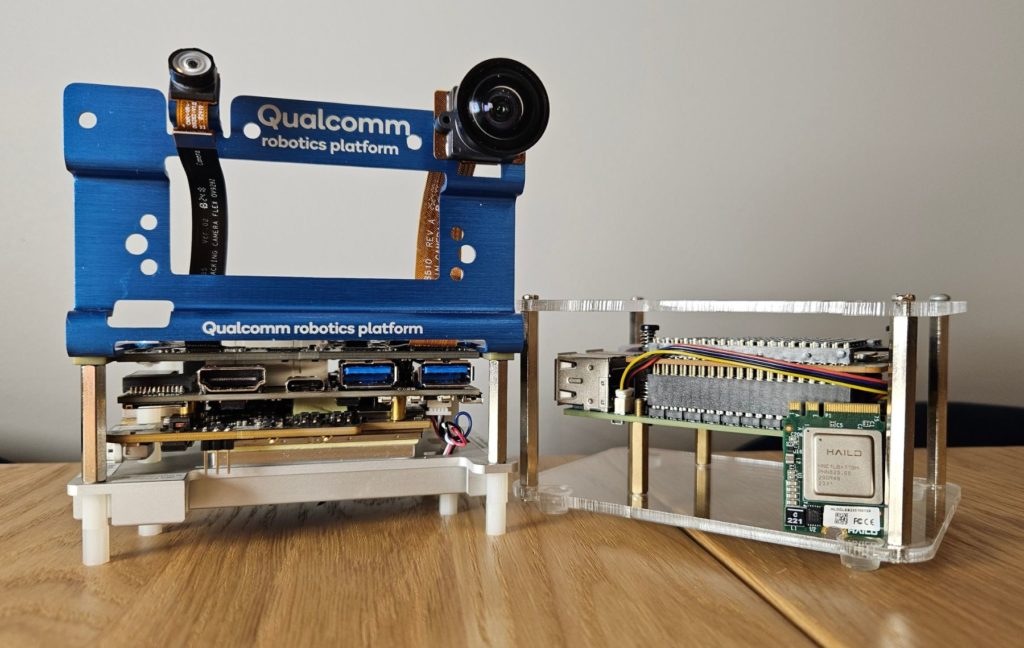
Choosing the Right NPU for Edge AI Solutions
The best NPU on paper may not run your model. We tested one open model on a Qualcomm chip and a Hailo chip to see […]

Articles
RAM is the new gold. Dig deeper for it with ZRAM
This article explores how much headroom you can still recover on broadband devices you have already deployed by compressing memory with ZRAM.

Articles
Generative AI at the Edge: What’s Possible in 2026
Advances in NPU capabilities and quantization have enabled more sophisticated AI models running locally for low-latency, lower-cost and secure applications.