
RAM is the new gold. Dig deeper for it with ZRAM
The memory shortage means that RAM prices are surging, and supply is set to stay tight. See how ZRAM and leaner scope recover memory on broadband devices.

Written by
Matt Clayton
Senior Solution Architect

Executive Summary (TL;DR)
This article explores how much headroom you can still recover on broadband devices you have already deployed by compressing memory with ZRAM.
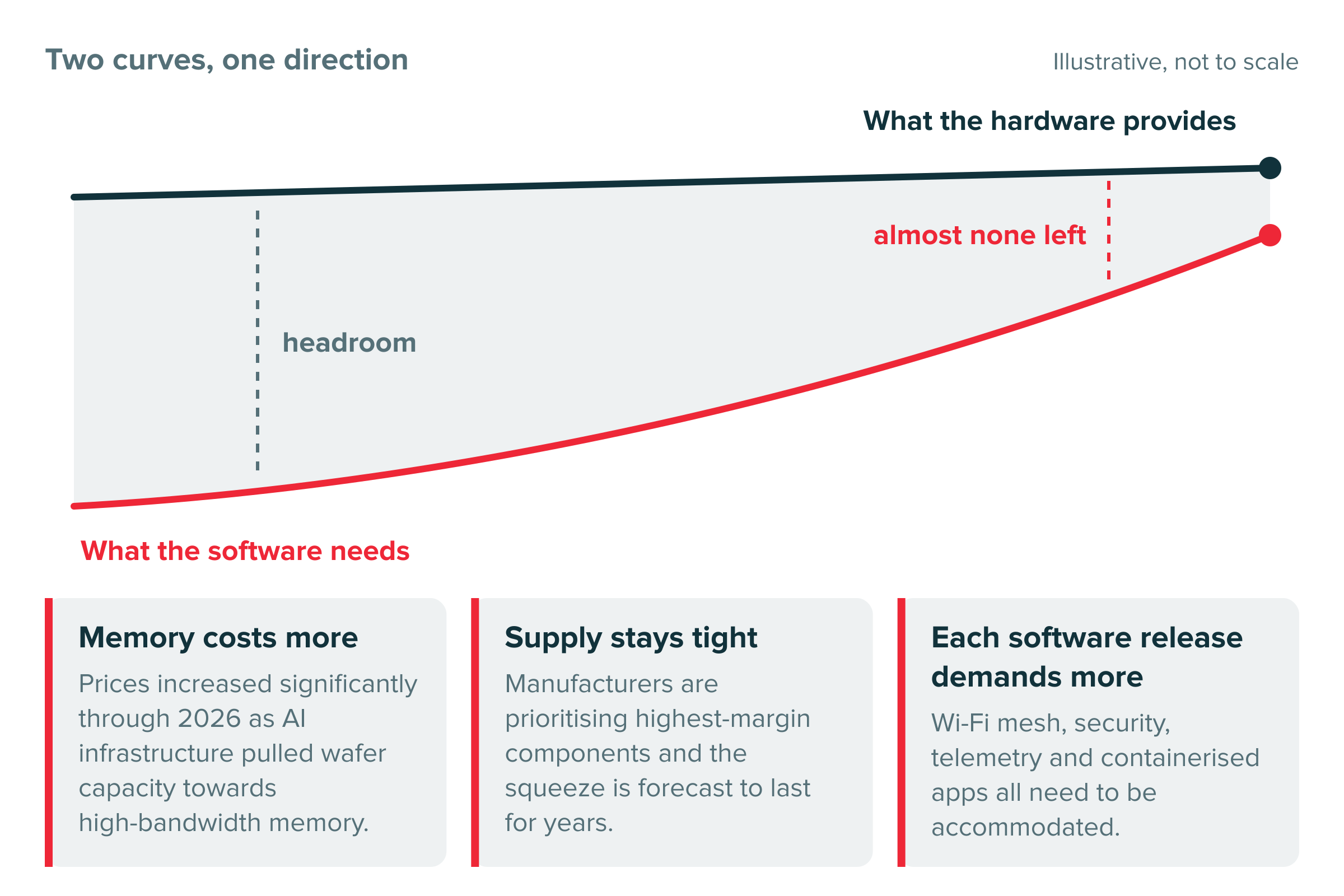
- Memory was a small line on the bill of materials (BOM) of a broadband device. With the current memory shortage, it is now a large one, and supply is expected to stay tight into 2027 and 2028.
- The software kept growing at the same time. Carrier-grade platforms do more with each release, so the squeeze comes from both sides at once.
- Leaner scope and compressed memory (with ZRAM) can recover real headroom on hardware you have already shipped.
- None of this requires new hardware, and you can start with part of your deployed fleet rather than all of it.
Adding RAM used to be the answer
For a long time, the way to add new capability on a broadband device was to specify a little more memory. It was a small cost, so nobody lost sleep over another 128MB.
That has quickly changed thanks to the current memory shortage. In February 2026, trade press reported that memory had grown from about 3% of a lower-end router’s bill of materials (BOM) a year earlier to around 20% or more (TelecomLead, Tom’s Hardware). DRAM contract prices have kept climbing since. In March, TrendForce projected that conventional DRAM contract prices would rise by 58% to 63% quarter-on-quarter in the second quarter of 2026 (TrendForce, March 2026). TrendForce News reported in October that fourth-quarter contract prices are expected to rise by about 20%, slower than earlier in the year (TrendForce, October 2026).
The main cause sits outside our industry. Memory makers are moving capacity towards high-bandwidth memory for AI accelerators and server applications (TrendForce, March 2026). High-bandwidth memory uses more wafer area per bit than ordinary DRAM, leaving less for everything else.
This is not a spike to wait out. Micron’s chief executive said in October that memory and storage supply and demand would be “much tighter in calendar 2027 and 2028 than they were in 2026” (Computerworld). Procurement cannot time its way around this, which leaves the bill-of-materials line that used to be easy to move as the one you control least.
Operators are feeling it. Counterpoint Research has warned that telcos’ broadband rollouts and plans for AI-capable CPE face headwinds (Telecoms.com). It shows up in RFPs, where requirements for more advanced Wi-Fi, mesh, security, telemetry and containerised applications now arrive alongside reduced memory configurations, delayed decisions and supply caveats.
What the memory is buying
Operators adopt a carrier-grade broadband platform for specific reasons. A standard data model means every device in a mixed fleet responds to the same question the same way. Remote management and diagnostics let them find faults without sending an engineer. Mesh Wi-Fi manages coverage as one network rather than box by box. Security can be updated centrally across the estate. Lifecycle management lets operators install a third-party service onto a gateway already in a customer’s home, without waiting for a firmware release.
Each of those features is code that has to live on the device, and each release adds more. A platform that does more this year than it did last needs more memory to do it. That growth bought real capability. It is also why a current release no longer fits comfortably on hardware specified a few years ago.
Simply adding more memory is no longer the easy way out.
You don’t need to upgrade your whole fleet at once
A deployed device fleet is rarely uniform. Different vendors, device generations, silicon, and memory configurations. It is tempting to treat this variance as a blocker, because any plan that must work everywhere must work on the weakest device in the estate.
It does not have to. Devices with headroom can take on new capability now: containerised services, managed remotely, added and withdrawn without a firmware release (the approach behind the Smart Router). The devices without it keep doing exactly what they do today, on the same platform and under the same management plane. Nothing regresses, and roll-out doesn’t get held back by the oldest hardware in the estate.
Open platforms turn lock-in into a porting problem
Porting software to hardware it wasn’t written for is common engineering work. A device fleet that feels locked to one vendor’s stack usually comes down to how much effort that port takes, and who does the work.
prplOS and RDK-B are examples of open platforms built to run across devices from different OEM vendors, rather than separate stacks per supplier.
prplWare is the prpl Foundation’s open-source suite for broadband devices. It brings together
- prplOS, an operating system built on OpenWrt;
- prplMesh for mesh Wi-Fi;
- prplLCM for managing containerised applications on devices already in the field;
- and the prpl high-level and low-level APIs (prpl Foundation).
prplLCM orchestration uses industry-standard tools such as the Broadband Forum’s USP and the TR-181 data model.
prplOS can be ported to virtually any device with enough RAM, and the benefits above do not depend on buying a new box from a different supplier.
Where the RAM goes on a broadband device
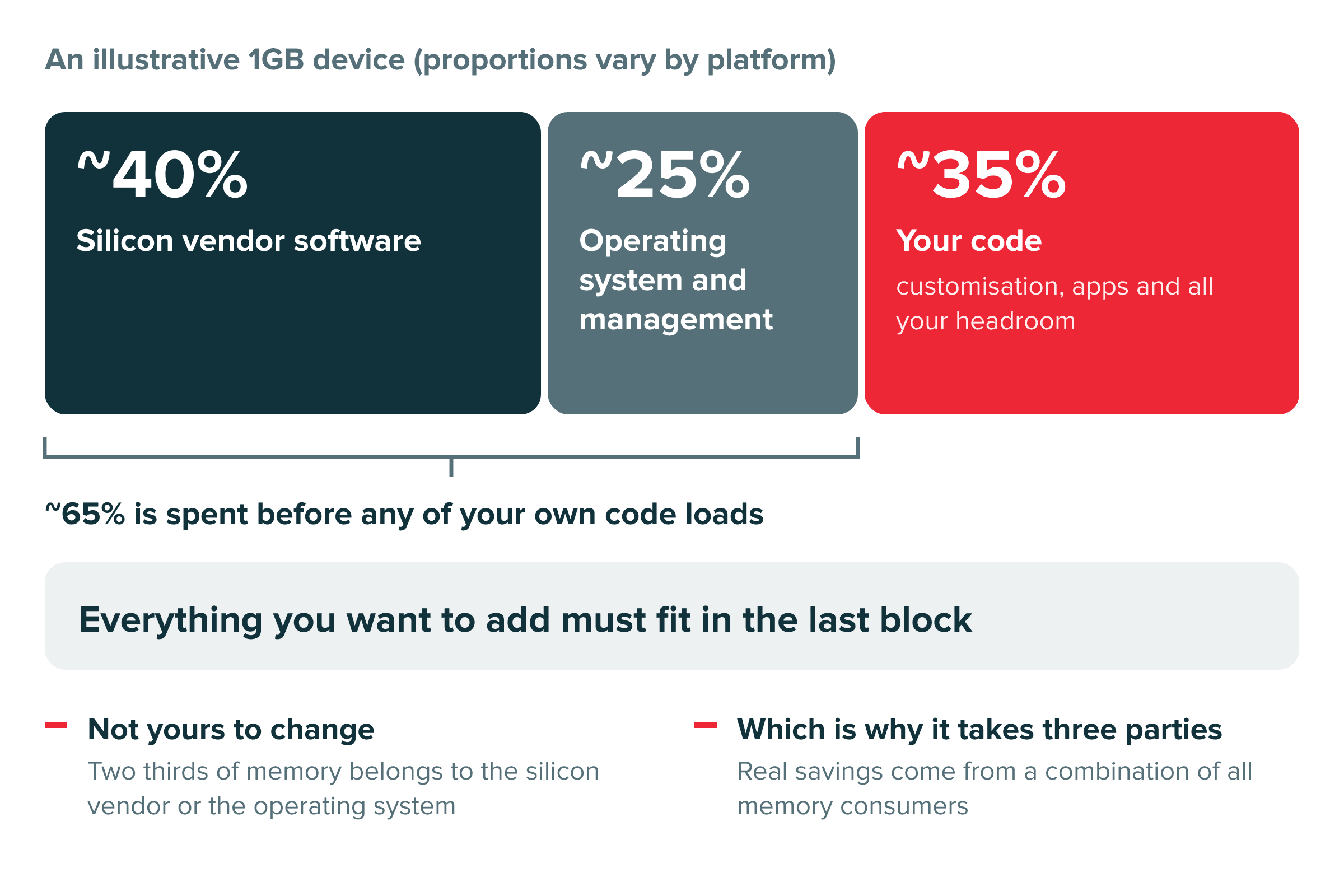
The first step is measuring where RAM goes. Most of the budget turns out not to be yours.
Take a 1GB device as an example. Proportions vary by platform, but the shape is generally consistent.
- The silicon vendor’s own software (drivers, packet buffers, hardware acceleration) typically takes about 40% of the budget before any of your code loads.
- The operating system and the management layer take around a quarter.
- That leaves about a third for product customisation, your applications and all of your working headroom.
This is why the conversation so often stalls. The team under pressure to find memory usually doesn’t own most of it. About two-thirds of it arrives with the silicon or the platform. Getting it back means working in all three places at once: with the silicon vendor, upstream in the platform, and in your own code.
ZRAM: compressing memory in place on broadband devices
One lever an operator can pull on its own, on hardware already in the field, is compression.
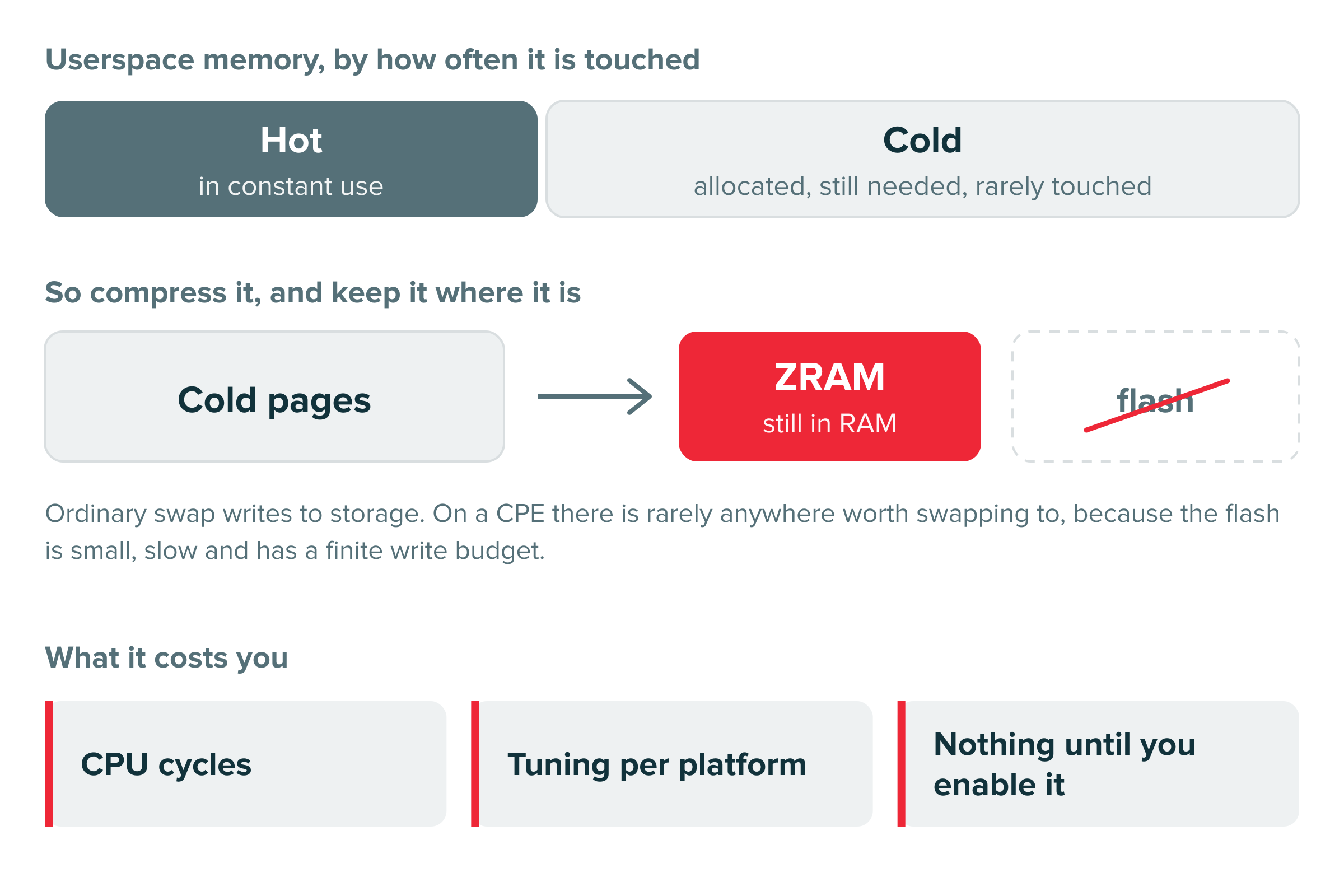
Devices do not use memory evenly. A running gateway holds a lot of state that is allocated, still needed and almost never touched: initialisation paths that ran once at boot, configuration read a few times a day, services that sit idle for most of it. It is all resident, and almost none of it is busy.
That is what compresses well, and that is what ZRAM targets. ZRAM is part of the mainline Linux kernel. Cold pages are memory that has not been used recently. Ordinary swap would write them to flash, which on a CPE is small, slow and has a finite write budget. ZRAM compresses them and keeps them in memory instead. The pages stay addressable, nothing is written to flash, and the device simply fits more into the same silicon.
Take an illustrative 512MB device with 128MB taken by the kernel, 256MB of user space in use and 128MB free. If half the user space is cold and compresses two-to-one, that 128MB becomes 64MB. Free memory rises from 128MB to 192MB, a 50% increase, and the device can use the equivalent of 12.5% more RAM. The hardware is unchanged.
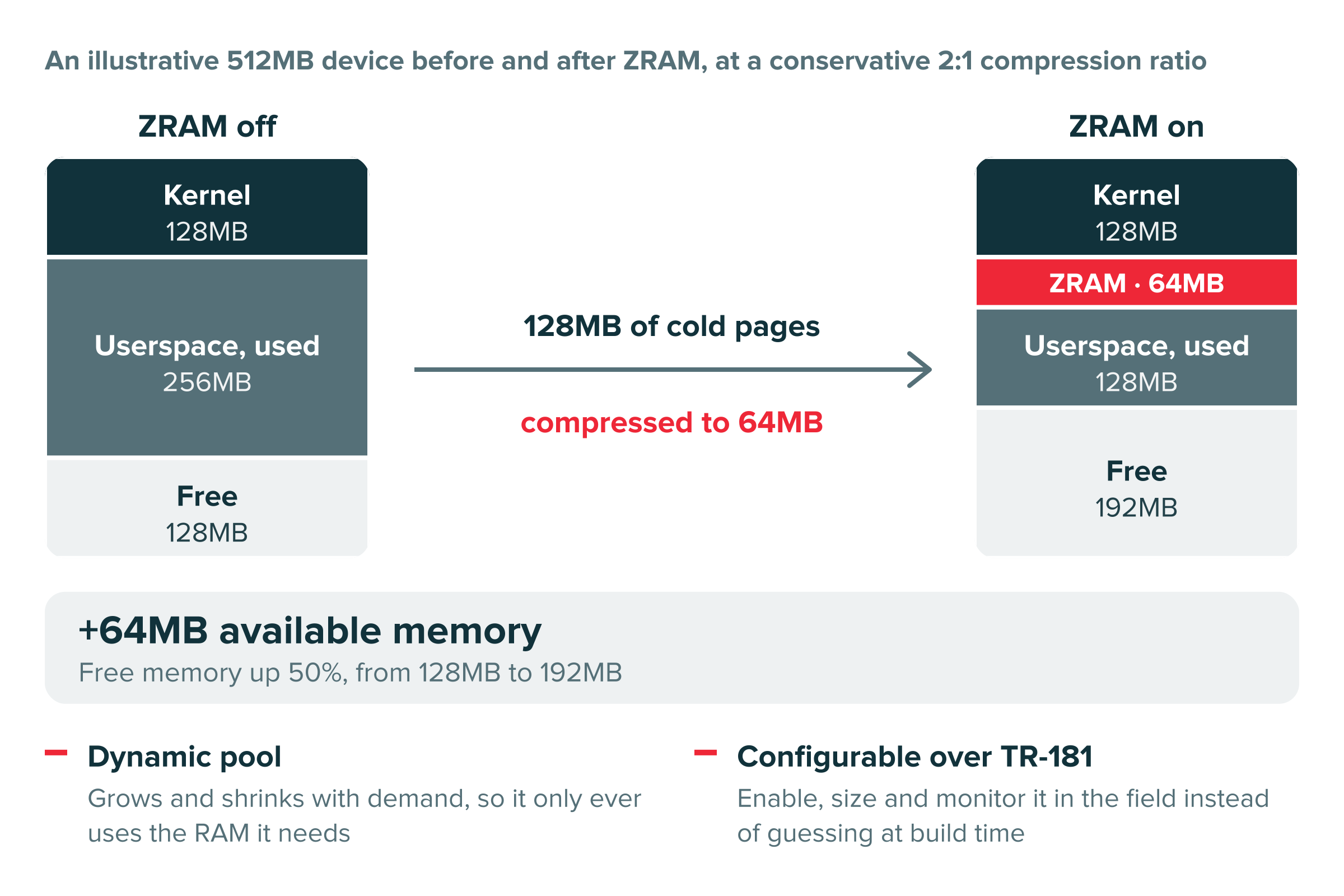
Two-to-one is a conservative expectation. On a prplWare device, we measured four-to-one, dropping the user space from 125MB to around 30MB. The pool is dynamic, growing and shrinking with demand and using only the RAM it needs, so imperfect sizing costs far less than it would with a fixed partition. It is configurable and monitorable over TR-181, so an operator can enable it, size it, watch the real compression ratio in the field, and turn it off again on a platform where it doesn’t add value.
ZRAM does have a cost. It uses CPU cycles to compress and decompress, and a badly sized pool can thrash, so test it per platform rather than applying a global default. It is off by default, so it costs nothing until somebody switches it on.
Consult Red has shipped memory compression across millions of customer-premises devices. Sooner or later, every product needs more RAM than it launched with.
Not every device needs every feature
Shipping the same build to every device means an entry-level gateway carries a feature scope designed for a flagship gateway. With device profiles, the software is configured per device class, so a build includes only the features the device will use. Every feature left out is memory, storage and CPU the device gets back.
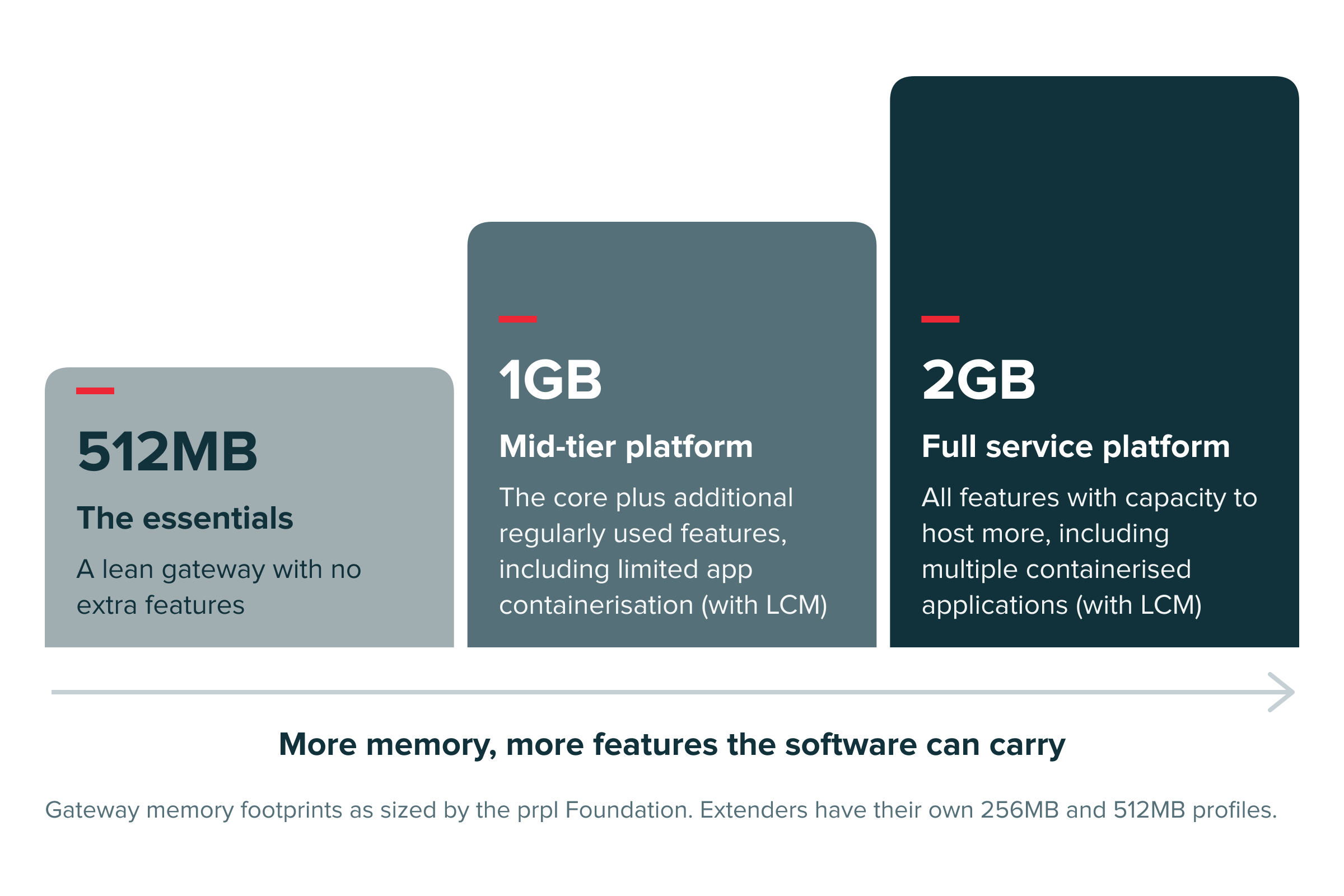
The industry is moving this way: the prpl Foundation has announced memory-based profiles for gateways and extenders. How far it can go depends on the platform and the services an operator wants to offer, and getting it right means knowing which features each device class really uses.
Done well, it turns your fleet into a map: some devices have room for revenue-generating services today, and others are better left doing the job they already do well.
No single fix
Compression alone will not solve memory availability challenges. Getting a modern release onto constrained hardware takes a combination of approaches:
- leaner core data structures and dynamic allocation
- fixing memory leaks
- dropping what a class of device doesn’t need
- compression
- more granular sub-modules so features can be excluded cleanly
- smaller SoC SDKs
It also takes more than one party. The silicon vendor’s software is the largest single consumer, and for good reason: drivers, packet buffers and hardware acceleration are not optional. The biggest savings therefore usually need the vendor in the room. The platform improves through its community of contributors. The applications are somebody else’s product. No single party can fix this alone, so start with what you can control.
Consult Red profiles real platforms to find where the memory goes, works inside the prpl and RDK communities, and helps operators and OEMs decide what a constrained device should carry and fit a current release onto hardware already deployed.
Buying your way out is no longer the cheap route, so the work now sits with engineering, where it can at least be started without waiting on a supplier.
Trying to fit more onto the broadband device fleet you already have?
Get in touch if you are fitting a new release onto deployed hardware, deciding what a constrained device should ship, planning a move to an open platform such as RDK-B or prplOS, or working out which of your devices can carry containerised services today.
Some images on this page are AI-generated and used for illustrative purposes.
Related Insights

Articles
Generative AI at the Edge: What’s Possible in 2026
Advances in NPU capabilities and quantization have enabled more sophisticated AI models running locally for low-latency, lower-cost and secure applications.
Articles
The Joy of PoCs
Why a small and early proof of concept (PoC) can save you much, much more in the long run.

Articles
Fastest Doesn’t Always Mean Best: Optimising an Edge AI Pipeline on Rubik Pi 3
The fastest Edge AI pipeline isn’t always the right one: Python, C++, and GStreamer on the Rubik Pi 3’s NPU, compared on speed, CPU, memory, […]