
Simply Explained: Why Your Router Should Be Doing the AI in the Connected Home

Written by
Rahul Mehra
CTO

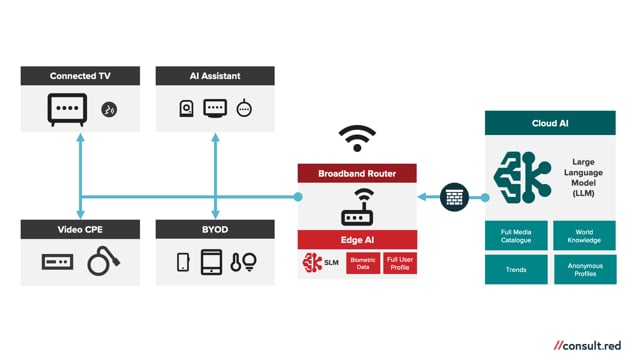
Large language models will continue to live in the cloud. What’s changing fast is the other half of the equation: local devices are now powerful enough to run small language models (SLMs) directly, and a hybrid architecture (cloud LLMs paired with edge SLMs) is quickly becoming the clear direction of travel for connected products.
Watch our CTO, Rahul Mehra, unpack the full case for anchoring edge AI in the broadband router below.
Why some AI has to move to the edge
Cloud LLMs are genuinely good at global search, catalogue-scale discovery and trend analysis. But time-sensitive, in-product tasks, voice, automation, and real-time control, don’t tolerate a round trip to someone else’s data centre. Every cloud inference adds to your OpEx, latency becomes noticeable, and reliability depends on infrastructure you don’t control.
The real question: where should the edge processing sit?
Once local processing is accepted as necessary, the harder question is where it should run in the connected home. A set-top box, a connected TV and a standalone AI device are all candidates, but each only sees part of the home. The router is different. It’s always on, sees every device on your network, including phones and smart TVs you don’t own, and is already trusted by all of them. Anchor edge AI there, and it becomes one foundation spanning media, apps, automation and voice, rather than another fragmented point solution.
Are you weighing where AI should sit on your network?
We design hybrid AI architectures end-to-end, from edge SLM to cloud LLM, on the same router platforms that operators already run. Talk to us about where AI should sit on your network.
Related Insights
Articles
Fastest Doesn’t Always Mean Best: Optimising an Edge AI Pipeline on Rubik Pi 3
The fastest Edge AI pipeline isn’t always the right one: Python, C++, and GStreamer on the Rubik Pi 3’s NPU, compared on speed, CPU, memory, […]
Case Studies
Secure Hardware Delivered at Speed
UK cybersecurity hardware specialist needed to compress a rapid, high-stakes carrier board design cycle for a new high-speed encryption product, with no margin for rework.
Articles
NPUs vs CPUs for Edge AI Vision: Less Heat, Less Power, More Headroom
Benchmarking industrial PPE detection – Raspberry Pi 5 vs Qualcomm QCS6490 (Rubik Pi 3)